The order you eat in: why the biggest meal belongs in the morning

Almost every piece of kitchen advice is about what goes on the plate. This one is about when. Timing is a separate variable, and on a ten-hour working day it is usually the one nobody has ever touched. What follows is how to move the weight of your eating toward the front of the day without cooking more than you already cook, what has to happen the night before for that to work at all, and a four-day test you can run this week for nothing.

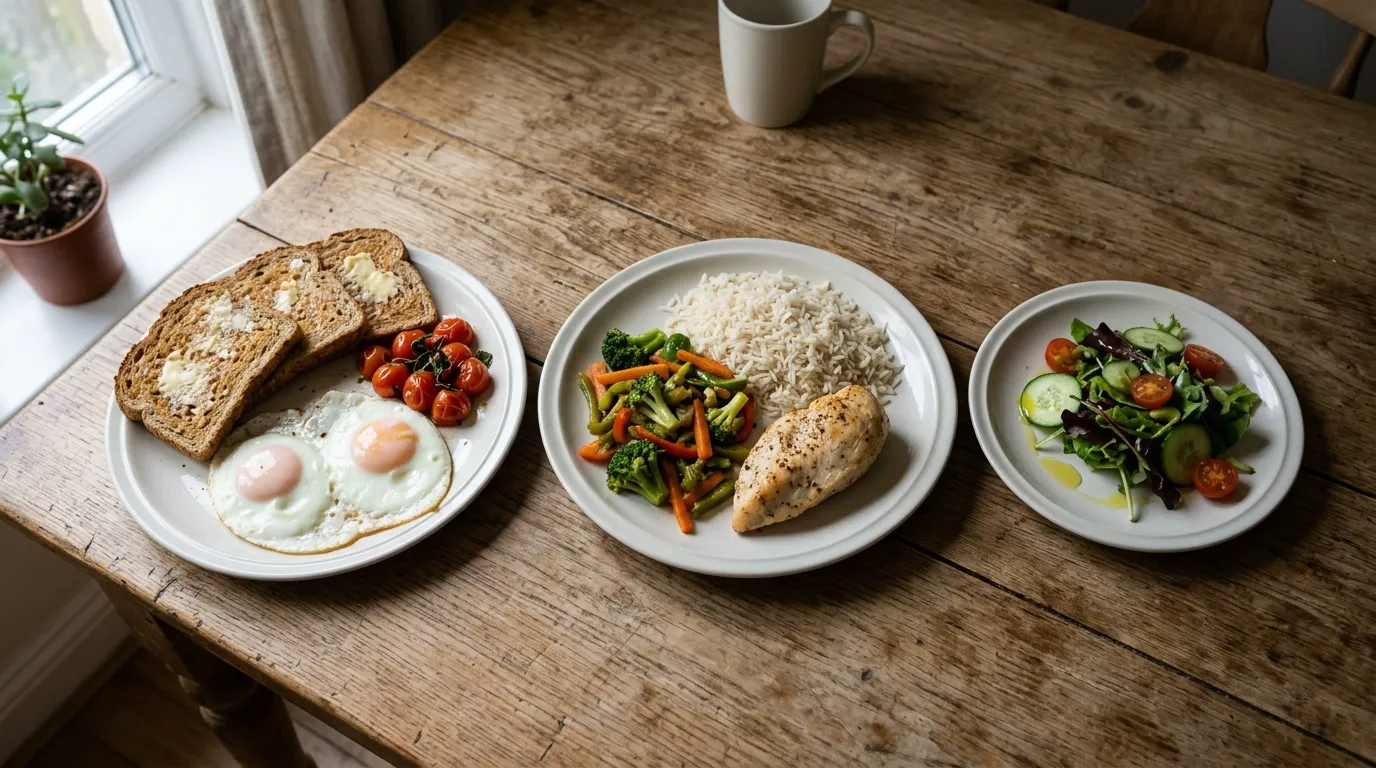
Three plates of everyday home food lined up left to right on a plain wooden table: a full plate of fried eggs, buttered toast and roasted tomatoes; a moderate plate of rice, mixed vegetables and a chicken breast; and a small plate with a green salad.
Publisher
Stone Creek Post
Page role
Article — meal order and daily timing
Written by
The Stone Creek Post editors, in-house
Published
2026-09-09
Last checked
2026-09-09
Revision
REV 01
01

Two variables, not one

Every meal has two settings. One is what is in it. The other is what hour it lands and how big it is relative to the rest of the day. You can leave the first setting completely alone and still change the shape of your day by moving the second.

Before you change anything, write down last Tuesday — not what you should have eaten, but what actually happened, with clock times. Most weeks look close to this:

7:00 coffee · 10:00 nothing · 13:30 lunch, 20 min · 16:00 something sweet · 21:00 dinner, largest meal of the day

That is a schedule, not a character flaw, and a schedule is a thing you can move. The proposal here is narrow on purpose: keep every single item of food you currently eat. Keep the grocery run. Keep the same total minutes at the stove. Change only which hour gets the big plate.

02

Why dinner became the main event

Dinner is the largest meal on most working days because it is the only slot with any room in it. In the morning you have somewhere to be, the kitchen is cold, and you are the only one awake. At nine at night, you are already sitting down, other people are in the room, and there is no next appointment.

Then it loops. A large meal at nine means very little appetite at six-thirty, so breakfast is coffee, so lunch is thin and rushed, so by four in the afternoon the sweet thing looks reasonable, and by nine you are eating the first proper meal of the day again. It is just a loop, and loops open at their weakest joint.

The weakest joint is the morning, because it is the only part of the day that nobody else has already booked. Your evening belongs to your family, your afternoon belongs to your job. Twelve minutes before seven in the morning belongs to you, and it is the cheapest twelve minutes you own.
03

Moving the weight forward without cooking more

The whole idea fits in one line.

The most complete meal of the day goes in the morning. The midday one carries you. The evening one is the lightest, not the heaviest.

This does not add cooking. If you currently make exactly one real meal a day — the thirty-five-minute one at nine at night — you still make exactly one real meal a day. You just make it at six-forty in the morning, in about twelve minutes, and the nine o'clock meal becomes the assembled one.

What that looks like in practice, with real quantities:

  • Morning, twelve minutes. Three eggs, two slices of bread, a pat of butter, and whatever fruit is in the bowl. Or last night's rice thrown in the pan with two eggs stirred through it and a spoon of whatever sauce is already open in the refrigerator door. Cook it in the pan you left out last night.
  • Midday, no cooking at all. The container you filled while clearing last night's table: roughly a cup and a half of rice or potatoes, a palm-sized piece of whatever protein got cooked, and something raw. Twenty rushed minutes is fine. Eating all of it is the part that matters, because the four o'clock patch usually shows up on the days the midday meal was thin.
  • Evening, six minutes. A piece of fish or chicken in the pan with a bag of salad and a tomato. Or soup and toast. Smaller than you are used to, and earlier if you can move it even forty-five minutes.
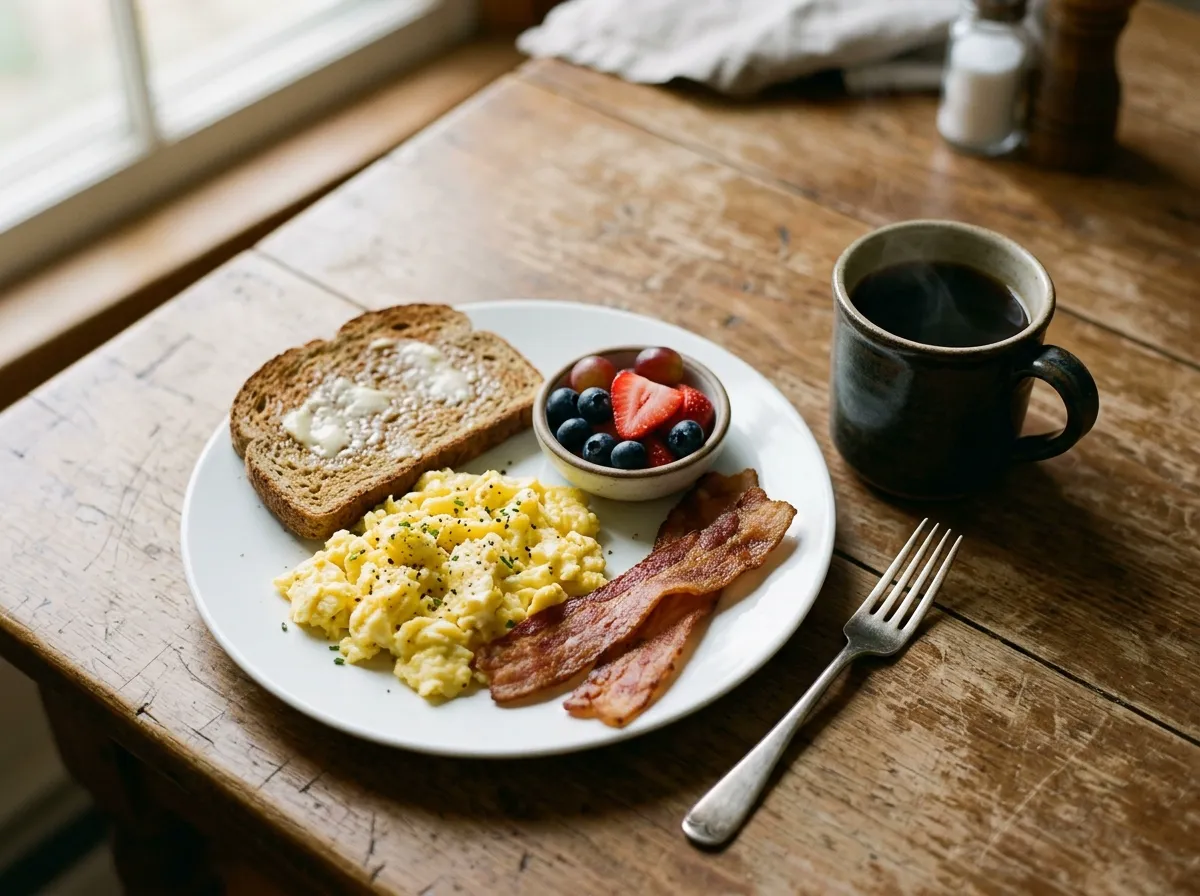
A full home breakfast on a plain white plate: scrambled eggs, two strips of bacon, a slice of buttered toast and a small bowl of berries, with a mug of black coffee and a fork beside it on a scratched wooden table in early morning window light.

Add it up and the stove time is the same or slightly less than what you were already doing. What changed is where in the day it sits. And one rule holds the whole thing together: no counting, no weighing, no logging of quantities. If a routine needs an app, it will not survive a bad March.

04

The night-before decision

Mornings do not fail in the morning. They fail the night before, because at six-forty a decision costs far more than it does at nine-fifteen. So the decision has to already be made by the time you are standing there in the dark.

Four minutes, while you are clearing the table anyway:

  1. Put the pan on the stove. Not in the cabinet — on the stove, where you will have to move it to do anything else.
  2. Move breakfast to the front of the refrigerator shelf at eye level. Eggs in front of the milk, not behind it. If bread lives in the freezer, take two slices out and leave them on the counter.
  3. Fill one container for tomorrow's midday meal from tonight's dinner, before you sit back down. After you sit back down, it does not happen.
  4. If the coffee machine has a timer, set it. If it does not, put the grounds in tonight.

The point of all four is the same: at six-forty you should be executing a decision, not making one.

When it goes wrong, and it will, do not try to cook your way out of it. If nothing was set up, two eggs scrambled hard take four minutes in a cold pan. A bowl of plain yogurt with anything solid on top takes forty seconds. The target is that the morning is not blank. The target is not a gold star.

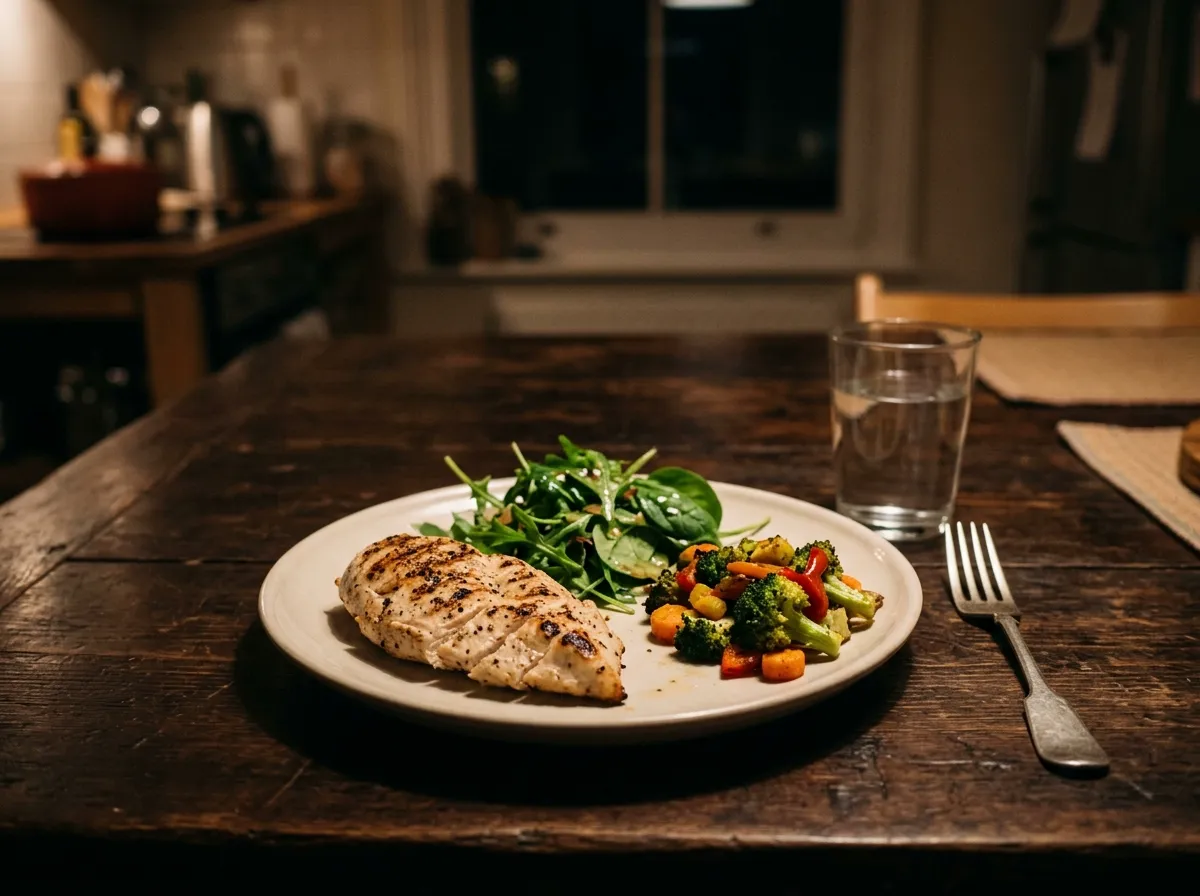
A small evening meal on a simple plate: a grilled chicken breast, a handful of salad leaves and a few roasted vegetables, with a glass of water and a fork on a dark wooden table in a home kitchen at night.
05

A four-day test

Four days, not thirty. Long enough to notice how the pattern behaves, short enough that you will actually finish it. Pick four weekdays, and tell whoever else cooks in the house — the evening meal is the one you are shrinking, and it is usually not only yours.

The rules for the four days are short. Buy nothing new. Do not increase your total cooking. Move the largest plate to the morning and the lightest to the evening. Write one line each night, on paper, on the refrigerator — what you ate, what time, and how the next morning started. That is the entire record:

Tue 19:40 soup and toast · Wed 6:30 hungry · Wed 6:45 ate

Three things tend to go sideways, and none of them mean the test failed:

  • Morning appetite may not show up right away. That usually means the night before was still the old size. Eat something small anyway — it is the evening meal that moves next, not the morning one.
  • Day three, dinner out with other people. Take it, eat what you want, and pick the thread back up at breakfast. Do not restart the count. A test you can only pass in a sealed room is not testing anything you actually live in.
  • You wake up twenty minutes late. Cut the morning meal in half. Do not cancel it. Cancelled is the version that becomes permanent.

On day five, read the four lines together and answer one question honestly: did enough change to be worth another two weeks. If the answer is no, you spent four days and no money, and you know something about your own schedule you did not know on Monday.

06

Try this week

  • Write down last Tuesday's actual clock — meals and times only, nothing else on the page.
  • Pick the four weekdays and say out loud, to whoever cooks with you, that the evening meal is getting smaller for four days.
  • Tonight, before you sit back down: pan on the stove, breakfast at the front of the shelf, one container filled.
  • Tomorrow, give the morning meal twelve minutes and make it the most complete plate of your day.
  • One line a night on paper. Read all four on day five, then decide.
07

More notes to read next

08

One note on the program we recommend

Affiliate disclosure

There is exactly one paid program recommended on this site: Flavorful Bites, a digital program — PDF and online access, with no physical item — sold by Man Boost Formulas on the Hotmart platform for US$29 one-time, with a 7-day refund window handled by Hotmart. Charged by Hotmart. If you're outside the United States, Hotmart shows the equivalent in your local currency at checkout. Stone Creek Post earns a commission if you buy through our link, and the price you pay is exactly the same either way. We did not create it, we did not test it, and we are not the seller. Everything in the article above is free and works without it. Our program page has the full details, including what it does not do.