Twelve minutes on the living room floor: movement for men who sit all day
Plans to move more usually die on logistics, not on willpower. What follows is a short routine you do at home — about twelve minutes, no equipment, no floor mat — organized around four things worth moving, plus the part nobody writes down: which patch of floor it happens on, which minute of the day it happens in, and what you do during the week it falls apart.
- Publisher
- Stone Creek Post
- Page role
- Article — short at-home movement
- Written by
- The Stone Creek Post editors — written and edited in-house
- Published
- 2026-09-09
- Last checked
- 2026-09-09
- Revision
- REV 01
Why the 6 a.m. gym plan keeps failing
Do the arithmetic on your own version before you blame yourself for the last one. Write down the drive there, the parking, the changing room, the time inside, the drive back. On most versions of that arithmetic the total lands north of an hour, and an hour has to beat everything else competing for that hour. Twelve minutes does not have to beat anything.
The second problem is how many places the plan can break before you have moved at all. Clean shorts. A packed bag. Shoes by the door. Keys. A car that starts in January. Traffic. A parking spot. Seven separate points where an ordinary Tuesday gets to win, and it only has to win one. The living room floor has one: the floor is clear, or it is covered in laundry.
This is not an argument against a gym. It is an argument for owning something that still happens on the days the gym does not.
Four things worth moving
Spine, hips, shoulders and wind. Four territories, three minutes each, twelve minutes total. You can hold it in your head after two runs, which matters more than any refinement: a routine you have to look up gets looked up twice and then abandoned.
The twelve minutes
- Minutes 0–3 · Spine. Hands and knees, round and arch slowly, 10 rounds. Then on your back, knees together, drop them side to side, 8 per side.
- Minutes 3–6 · Hips. Half-kneeling, back knee down, hips pushed forward, 60 seconds per side. Then hold the bottom of a squat, hands on a door frame, 3 × 30 seconds.
- Minutes 6–9 · Shoulders. Back against a wall, arms up and down like a slow snow angel, 10 slides. Then hands clasped behind your back, lift, 5 × 10 seconds.
- Minutes 9–12 · Wind. March in place or step onto the bottom stair, 40 seconds on, 20 seconds standing still, 3 rounds.
Four notes that save you learning them the slow way. On the spine minutes, move at the speed of your breathing rather than counting fast: ten slow rounds take close to a minute, not fifteen seconds. On the hips, half-kneeling does nothing if your back is arched — tuck your hips under first, then lean, and the position gets much smaller and much more honest. On the shoulders, if your hands leave the wall on the way up, stop where they still touch and work there. On the wind minutes, pick the version you can do in socks without waking anyone below you.
Nothing on this site is medical advice. If a shape does not feel right, make it smaller or drop it and spend the minutes on one of the other three.
Where in the house, and when
Pick the spot with a test, not an intention. Lie on your back somewhere in the house and stretch your arms overhead. If you fit without moving furniture, that is the spot — roughly six feet by three. If you had to shove a coffee table aside, move that table permanently, today, or pick a different spot. A routine that needs a room rearranged every morning has an extra step, and the extra step is where it dies.
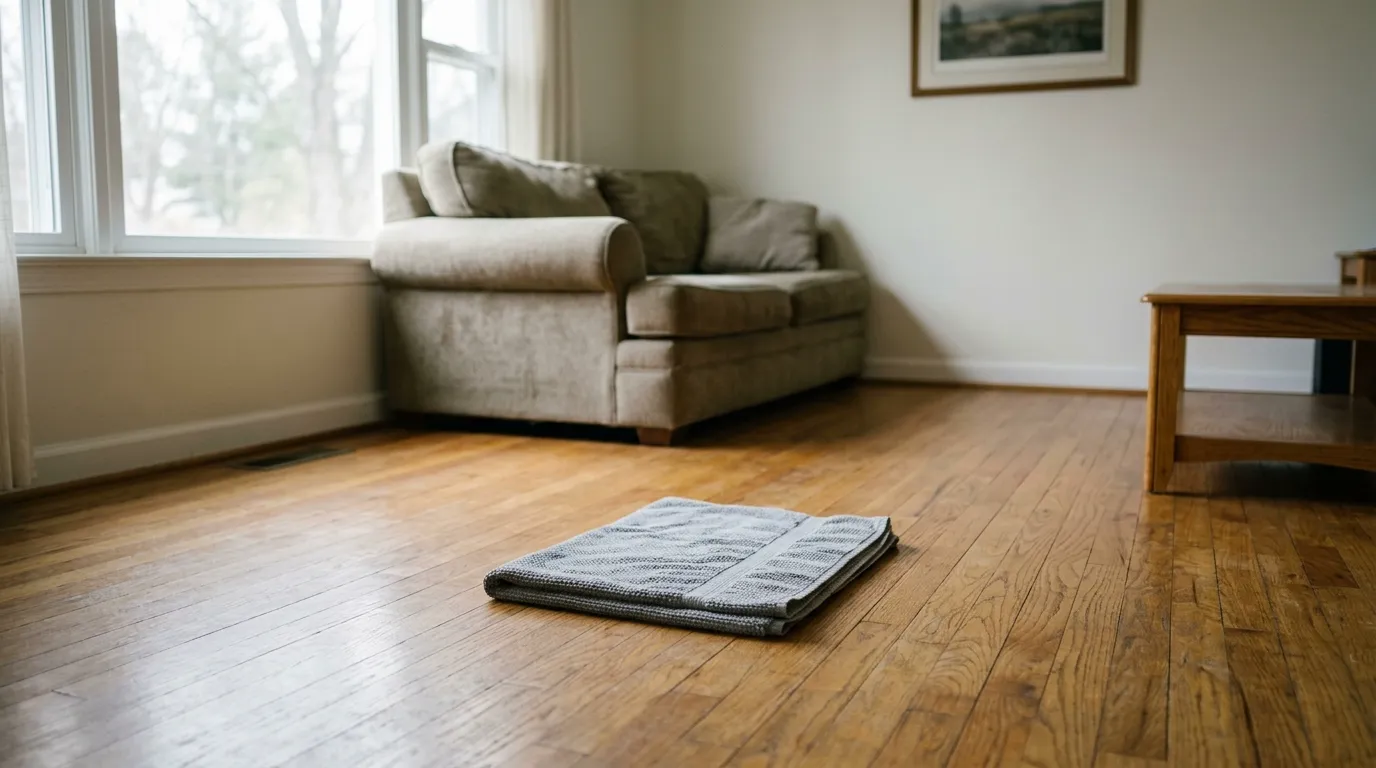
Leave a folded bath towel on that patch and do not put it away. Storing it is the failure in miniature: a towel in the closet means opening the closet, which means deciding, and deciding at 6 a.m. goes badly.
For the when, do not pick a time. Pick an anchor — something that already happens without a decision — and put the twelve minutes immediately before it. Three that hold up:
- Before the shower. The strongest anchor in the house, because you were going to shower anyway and no longer have to care about sweating.
- While the coffee brews. Honest about its limits: most drip pots run four to six minutes, so this anchor buys the short version, not the full twelve.
- Before you sit down in the evening. Shoes off, keys down, floor. The twelve minutes go before the sit. After the sit, the couch wins, and it wins every time.
Three levels, and how to pick yours
Pick by what the floor costs you, not by what you used to be able to do. Get down and stand back up once. If that is the hardest thing in the next twelve minutes, you are at level one.
Level one — nothing on the floor
Six to eight minutes, standing or in a dining chair. Spine: sit tall, round and arch, 10 rounds. Hips: hold the chair back, take a long step back and drop your weight, 45 seconds per side. Shoulders: the same wall slides, standing. Wind: march in place, 30 seconds on, 30 off, 3 rounds. Separately, once a day, stand up from the chair and sit back down five times without using your hands.
Level two — the full twelve
The list above, as written, once through. This is the whole routine — there is no reason to move past it, and staying here is not a failure of ambition.
Level three — you used to train and you stopped
Same territories, same twelve minutes, three changes: hold the hip positions 90 seconds instead of 60, take five full seconds to lower into every shape, and add two slow trips across the room carrying something heavy in one hand — a watering can, a bag of rice — switching hands at the wall. Resist rebuilding your old program on top of this. The old program is the one that stopped.
Move up only when the current version has been boring for two straight weeks, not because one morning felt good. Boredom means it has gone automatic, and automatic is the point.
What to do on a bad week
Every routine meets a week with a deadline, a sick kid or four nights away from home in it. The one that survives has a written-down small version, decided in advance while you are calm rather than renegotiated at 10 p.m. when you are not.
- The three-minute version. One territory, all three minutes. Default to hips if you sat in a chair all day, spine if you drove.
- The ninety-second floor. The number that is never zero. Stand up, hinge forward with soft knees, let your arms hang, then take ten slow breaths. That is the whole obligation on the worst day of the month.
- Never two in a row. One skipped day is a skipped day. Two is the start of the next six-month gap. If you skipped yesterday, today is the ninety-second version at minimum.
- Away from home. Same four territories on hotel carpet, no towel. Swap the stair for marching if you are above someone.
- Late at night. Do the spine three minutes and go to bed. Running the full twelve at eleven o'clock to settle a debt with yourself is what makes tomorrow feel like punishment.
- Company. A dog or a small child will climb on you during the floor minutes. It is twelve minutes. Let them.
Decide one more thing now, while it is theoretical: what happens after you miss a whole week. Restart one level below where you left off, for four days, then go back.
Try this week
- Run the lie-down test tonight and pick the patch of floor. Move whatever is in the way once, for good.
- Put a folded bath towel on that patch and leave it there all week.
- Name your anchor and write it where you already look in the morning.
- Run the twelve minutes twice this week, at the level you actually picked.
- Write down your ninety-second version before the week gives you a reason to need it.
More notes to read next
-
01
The order you eat in: why the biggest meal belongs in the morning
Timing treated as a variable separate from content, and what changes in your kitchen when the weight of the day moves forward.
-
02
Twelve minutes, one pan: cooking something decent after a ten-hour day
One pan, four pantry items that are always in the house, and three combinations you can make without reading anything.
-
04
One page, one trip: planning a grocery run you'll actually follow
Build the list from three repeatable dinners, write it in aisle order, and keep the whole thing to a single page.
One note on the program we recommend
Affiliate disclosure
Stone Creek Post recommends one paid program as an affiliate: Flavorful Bites, a digital program — PDF and online access, no physical item — sold by Man Boost Formulas on Hotmart. If you buy through our link we earn a commission from Hotmart, and the price you pay is exactly the same. We are not the creator or the seller, and we did not test it. According to the seller's presentation, one of its five parts is a twelve-minute at-home movement routine with no equipment, in three levels — which is why it sits next to this article rather than inside it. Price is US$29, one-time, no subscription; charged by Hotmart, with a 7-day refund window handled by Hotmart directly, and access delivered by email within minutes of purchase. If you're outside the United States, Hotmart shows the equivalent in your local currency at checkout. Everything in the article above is free and works without it.