Twelve minutes, one pan: cooking something decent after a ten-hour day
Twelve minutes is not the hard part. What ends the evening in a bowl of cereal at nine is everything wrapped around those twelve minutes: standing at the open refrigerator deciding, finding out the one thing you needed is gone, and looking at the sink afterward. This is a short method for removing all three.
- Publisher
- Stone Creek Post
- Page role
- Article — practical cooking notes
- Written by
- The Stone Creek Post editors
- Published
- 2026-09-09
- Last checked
- 2026-09-09
- Revision
- REV 01
The real cost isn't the twelve minutes
A weeknight that ends without a cooked meal breaks into three costs, and only one is cooking.
The first is deciding: six or seven minutes at the refrigerator, looking at things that could become a meal but have not been assigned to one. The second is the gap, when you settle on something and the last two eggs or the rice is gone. That is where takeout wins, before the pan is ever on the stove. The third is the cleanup, and it decides whether you cook again tomorrow. One skillet, one board and one knife is a four-minute wash. A skillet, a saucepan, a sheet tray, a colander and a bowl is fifteen, longer than the meal took.
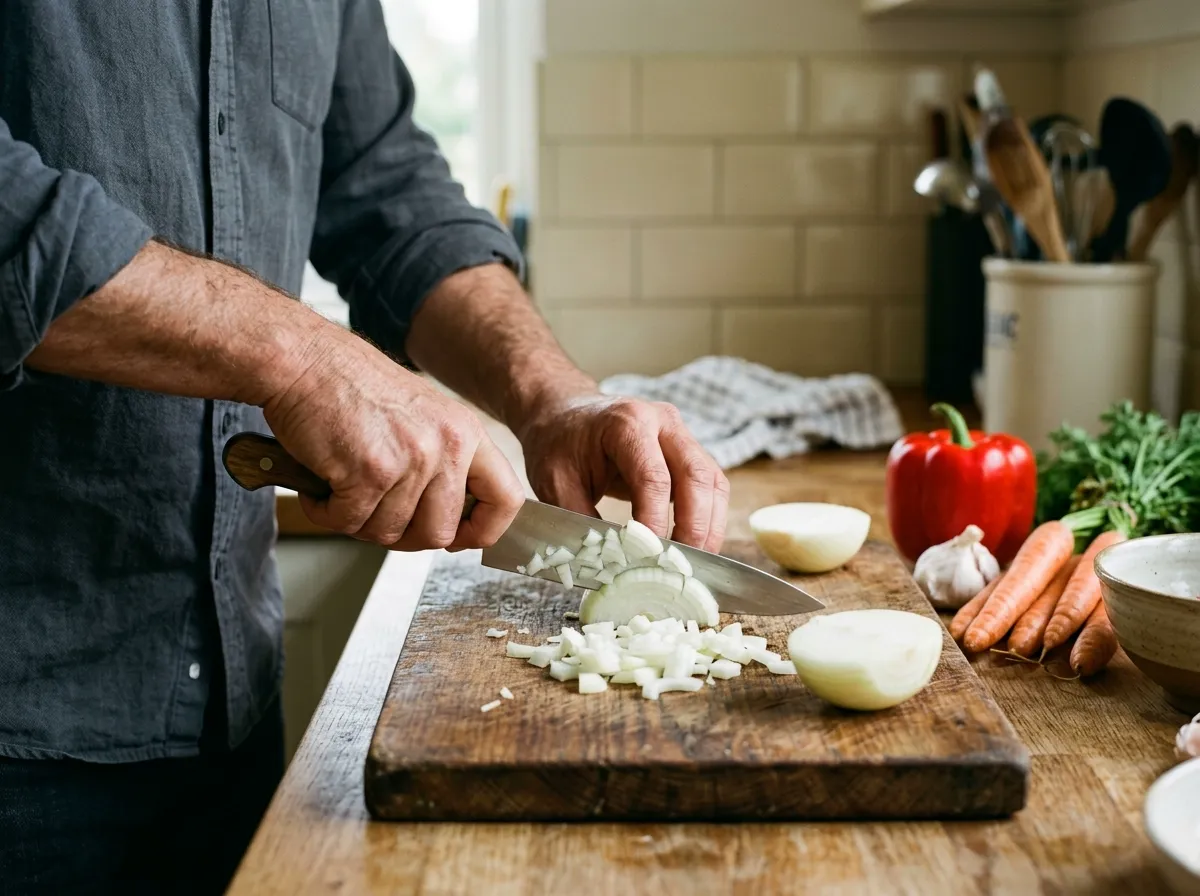
None of what follows is about knife skills: three fixed choices, four staples, one pan.
One pan, and why that matters
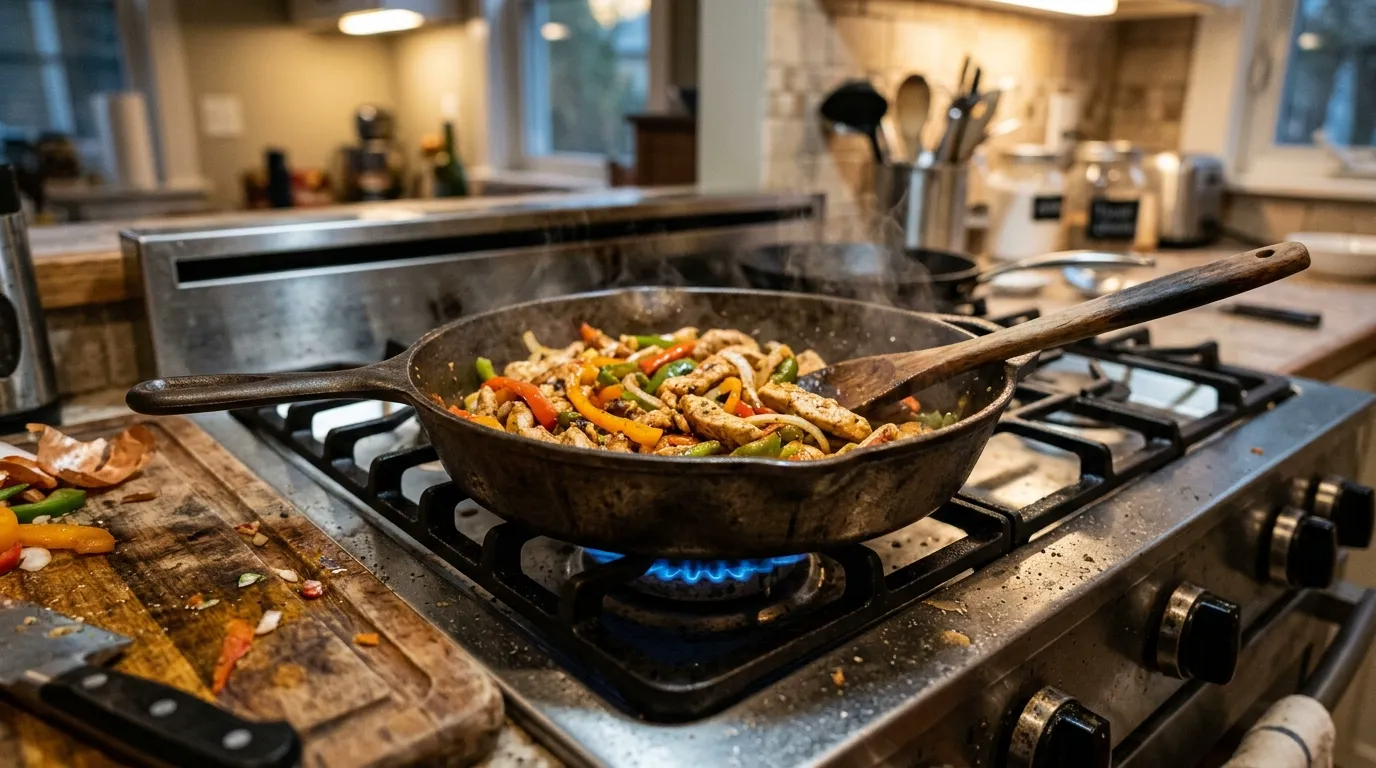
A twelve-inch skillet, cast iron or heavy stainless, deep enough to take a lid. Everything happens in it, in the same sequence, every time.
- Pan on medium-high, empty, while you cut. Two minutes. A pan that is already hot is most of what people call technique.
- One tablespoon of oil. It should move like water when you tilt the pan.
- Whatever browns goes first, in one layer, untouched for three minutes.
- Whatever softens goes second: onion three minutes, peppers three, mushrooms four.
- Whatever only needs warming goes last: canned beans two minutes, spinach one, garlic forty-five seconds.
- A splash of water or soy sauce, lid on, one minute. That last minute is what makes a fast meal taste finished instead of dry.
Things go in by how long they need, longest first, and almost nothing needs more than six minutes if it is cut small enough. A whole chicken breast takes twenty minutes. Sliced a quarter-inch thick, against the grain, it takes six. Thin slicing is not a refinement here. It is the entire trick.
When it goes wrong
Everything turned gray and wet. The pan was crowded, and the food gave up water faster than the pan could drive it off. Cook it in two rounds next time, or add a sauce at the end. A crowded pan still makes dinner. It just does not brown.
It is stuck to the pan. It is not. Protein releases on its own once a crust forms underneath. Leave it a minute, then lift with the edge of a spatula rather than the flat.
Four things that should always be in the house
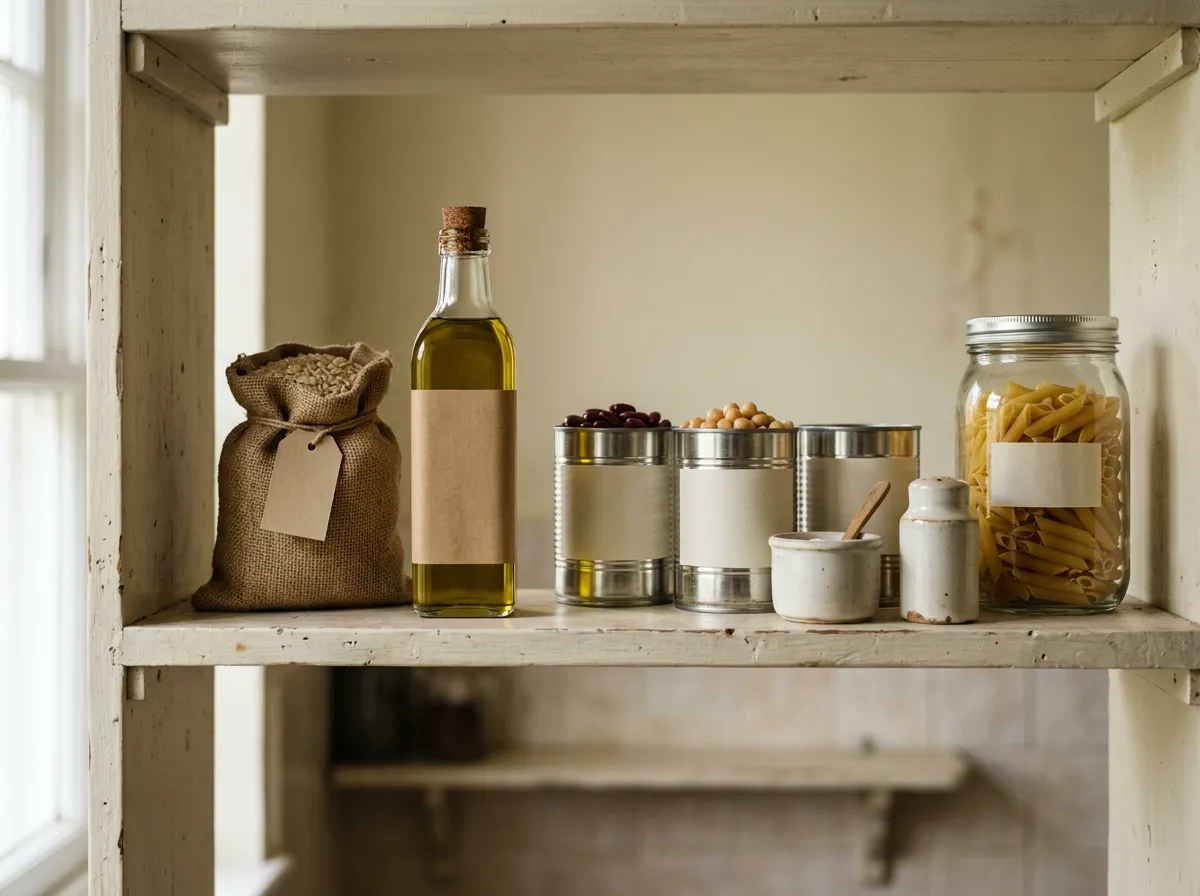
Four categories, and the house is never out of any of them.
- A dozen eggs. Three minutes to a hot meal at any hour, and the one protein that never needs planning.
- A starch that cooks unattended. Rice, pasta, or tortillas in the freezer. It cooks while you do something else, or needs no cooking at all.
- Two cans of beans and one of tomatoes. Beans are protein that is already done. Tomatoes turn whatever is in the pan into something with a sauce.
- An acid and a salty condiment. A lemon or vinegar, plus soy sauce or hot sauce. This is the difference between food that tastes plain and food that tastes cooked on purpose.
Two additions worth the freezer space: chopped onion and peppers, frozen. They go into a hot pan straight from the bag and delete the part most people dislike, standing at the board with a knife at 7:40.
The replacement rule matters more than the list: buy a new one the day you open the last one, not the day you run out. That is what keeps the gap from happening on a Wednesday.
Three combinations you can make without reading anything
Three is the number: two gets boring by the second week, five means you are deciding again. Each is written to be memorized rather than followed.
Eggs and beans in the skillet
About eight minutes · One pan- Oil in the hot pan, half a chopped onion or a handful from the freezer bag. Three minutes, stirring twice.
- One can of beans, drained, two minutes. Press a few flat with the back of the spoon.
- Three shallow wells with the spoon, an egg in each. Lid on. Three minutes for a soft yolk, four for firm.
- Hot sauce, black pepper, a squeeze of lemon. Eat it out of the pan with toast.
Chicken, onion, pepper
About twelve minutes · One pan- Slice one chicken breast a quarter-inch thick, against the grain, and salt it on the board while the pan heats.
- Oil, then the chicken in one layer. Three minutes untouched, flip, two more. Out onto a plate.
- Onion and pepper into the same pan, four minutes. The brown bits the chicken left come up into the vegetables, which is the whole reason for one pan.
- Chicken back in, a tablespoon each of soy sauce and water, lid on, one minute.
- Over rice, or folded into tortillas.
Pasta and whatever is green
About twelve minutes · Pan and pot- Salted water on the heat first. It boils while you do the rest.
- Pasta in, nine to ten minutes. For the last two, drop broccoli florets or a cup of frozen peas into the same water.
- Meanwhile: oil in the skillet on medium, two cloves of sliced garlic, forty-five seconds. Garlic turns bitter at about sixty, so it goes last and gets watched.
- Add the can of tomatoes, or use a ladle of pasta water with a spoonful of butter instead.
- Drain, tip it into the skillet, stir thirty seconds. Black pepper and grated cheese.
When it goes wrong
It tastes like nothing. Almost always salt, added too late. Salt the protein on the board, the vegetables in the pan, the pasta water until it tastes like the sea, then finish with the acid off the heat. Acid at the end is what most home cooking is missing.
The garlic went brown and bitter. It cannot be rescued and it will flavor the whole pan. Wipe the pan and start it again.
It came out watery. Lid off, heat up, two minutes.
Cook once, eat twice
The second meal is where twelve minutes becomes three. The mistake is doubling the whole recipe. Double only what took longest, the protein: two chicken breasts instead of one add about three minutes, same pan, same heat, second batch. Two cans of beans add nothing. Do not double anything crisp or dressed with fresh greens, because neither survives a night in a container.
Put the extra in a shallow container, lid off until it stops steaming, about ten minutes, then cover it. A deep container with the lid slammed on hot is how leftovers turn into a wet gray block nobody eats. Keep the rule plain: what you cooked Monday gets eaten by Wednesday.
Reheat in the same pan: splash of water, lid on, medium, two minutes. A dry pan on high is what makes reheated chicken taste like reheated chicken. After that the three-minute meals write themselves — cold chicken strips in a tortilla with hot sauce, beans and rice back in the skillet with an egg on top. None of it requires a decision at 7:40, which was the real problem the whole time.
Try this week
- Buy the four categories on one trip: a dozen eggs, one starch, two cans of beans and one of tomatoes, a lemon, and soy sauce or hot sauce.
- Cook two of the three combinations above, once each. Do not add the third until both need no thinking.
- On one of those nights, double the protein and eat the rest the next day. Time it: it should come in under five minutes.
- Count the dishes each night. If it is more than a pan, a board, a knife and a plate, find the extra and cut it.
More notes
-
01
The order you eat in: why the biggest meal belongs in the morning
Frames the timing of a meal as a variable separate from its contents, and shows how to redistribute the same food across morning, midday and evening without cooking more in total.
-
03
Twelve minutes on the living room floor: movement for men who sit all day
A short routine at home with no equipment, organized around spine, hips, shoulders and breathing, with three levels to pick from and a plan for the week that falls apart.
-
04
One page, one trip: planning a grocery run you'll actually follow
How to build a single-page list anchored to three repeatable dinners and one fixed breakfast, written in the order of the aisles, in about ten minutes on a Saturday.
A note on the one program we recommend
Affiliate disclosure
Stone Creek Post recommends Flavorful Bites as an affiliate. If you buy through a link on this page, we earn a commission from Hotmart. The price you pay is exactly the same. We are not the creator or the seller of the program.
We recommend one paid program on this site: Flavorful Bites, a one-time digital program sold by Man Boost Formulas on Hotmart, listed at US$29 on its Hotmart checkout page. In the seller's presentation, it is one payment, with no subscription and no renewal, and access is permanent. The presentation also states a 7-day no-questions-asked refund guarantee handled by Hotmart. Charged by Hotmart. If you're outside the United States, Hotmart shows the equivalent in your local currency at checkout. It covers the same ground as this page, including a recipe collection the creator describes as written for a man who does not cook, built on a normal grocery list, with most of it done in under fifteen minutes, according to the presentation. We did not create it and we did not test it. Here is our full write-up, including what the creator says it does not do.